 by
by Some NBA games are just games. But others? They’re wars. Fueled by bad blood, playoff heartbreak, and superstar clashes — that’s what rivalries are made of.
You’re watching two teams that genuinely can’t stand each other, where every possession matters, every hard foul sends a message, and every clutch shot feels like a dagger to the heart of an entire fanbase.
That’s when basketball transcends sport and becomes pure theater — the kind of drama that has you texting your friends at midnight, rewatching highlights until your eyes hurt, and planning your vacation around playoff schedules.
These aren’t just competitive matchups between good teams. We’re talking about rivalries that defined entire eras, built Hall of Fame legacies, and turned casual fans into ride-or-die basketball junkies.
Some were built on geography, others on personality clashes, and a few were just pure basketball destiny — the kind of magnetic hatred that made the league appointment television.
Top 10 NBA Rivalries That Shaped the Game
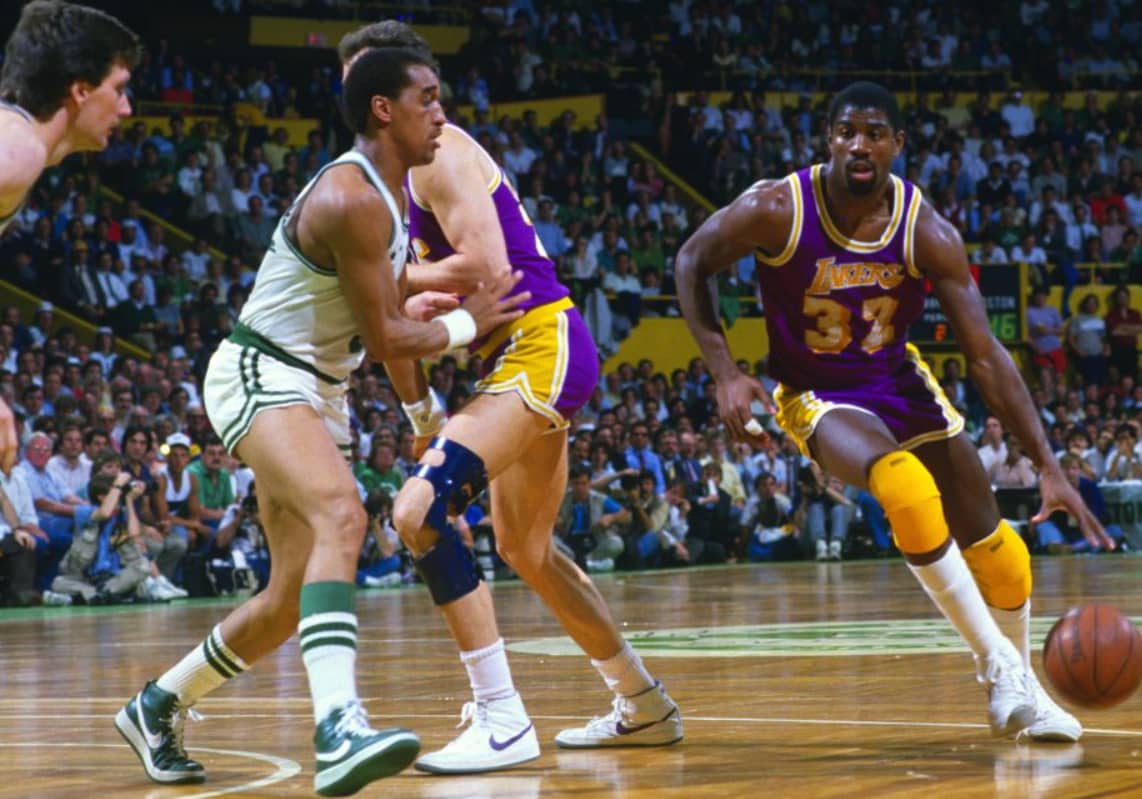
From the showtime battles of the 1980s to the modern superteam era, these rivalries have given us the most unforgettable moments in basketball history.
They’ve pushed players to greatness, driven ratings through the roof, and created the emotional investment that makes the NBA more than just a sport — it’s a year-round soap opera with sneakers.
Get ready for the most iconic, game-changing rivalries that helped shape the league into the global phenomenon we know and love today.
The Ultimate Rivalry Rankings
| Rank | Rivalry Name | Peak Era | Notable Players Involved | Championship/Playoff Meetings | Why It Mattered |
| 1 | Celtics vs Lakers | 1980s | Bird, Magic, Kareem, McHale | 3 Finals (1984, 1985, 1987) | Saved the NBA, defined an era |
| 2 | Jordan vs Bad Boys Pistons | 1988-1991 | Jordan, Thomas, Laimbeer, Dumars | 4 straight playoff meetings | Jordan’s final test before greatness |
| 3 | LeBron vs Warriors | 2015-2018 | LeBron, Curry, Durant, Thompson | 4 straight Finals | Modern superteam era defining |
| 4 | Russell vs Chamberlain | 1960s | Russell, Chamberlain | 8 playoff meetings | Greatest individual rivalry ever |
| 5 | Reggie vs Knicks | 1990s | Miller, Ewing, Starks | 6 playoff series | One man vs an entire city |
| 6 | LeBron vs Celtics | 2008-2018 | LeBron, Pierce, Garnett, Allen | 7 playoff series | King’s path to the throne |
| 7 | Knicks vs Heat | 1997-2000 | Mourning, Johnson, Ewing | 4 straight playoff meetings | Pure heavyweight boxing |
| 8 | Lakers vs Suns | 2006-2010 | Kobe, Nash, Stoudemire | Multiple playoff series | Speed vs skill clash |
| 9 | Spurs vs Suns | 2005-2010 | Duncan, Nash, Stoudemire | 3 playoff series | Fundamentals vs revolution |
| 10 | Spurs vs Mavs | 2001-2014 | Duncan, Nowitzki, Parker | 6 playoff series | Texas basketball supremacy |
The Battles That Built the League
#1: Boston Celtics vs Los Angeles Lakers (Bird vs Magic Era)
The rivalry that literally saved basketball.
When Larry Bird and Magic Johnson walked into the NBA in 1979, the league was on life support. Finals games were being shown on tape delay, attendance was dropping, and basketball felt like a niche sport fighting for relevance. Then these two transcendent talents started going at each other’s throats, and suddenly everyone was paying attention.
Their college rivalry from the 1979 NCAA championship carried seamlessly into the pros, where Bird’s blue-collar Boston grittiness clashed perfectly with Magic’s Hollywood showtime flair. These weren’t just basketball games — they were cultural events that divided the country along geographical and philosophical lines.
The 1984 Finals set the tone: seven games of pure basketball poetry, with Bird’s Celtics squeaking out a victory in what felt like a boxing match played with basketballs. The 1985 rematch saw Magic get his revenge, while 1987 became Johnson’s masterpiece as he outdueled Bird on the biggest stage. Magic earned bragging rights with a 2-1 Finals record against Bird, but both men elevated each other to legendary status. TV ratings skyrocketed, arenas sold out nationwide, and the NBA transformed from a struggling league to a global entertainment empire. Without Bird vs Magic, there might not have been a Jordan era, and no LeBron vs Curry. This rivalry didn’t just shape the game — it saved it.
#2: Michael Jordan vs Detroit Pistons (The Last Obstacle)
Before Jordan could be the GOAT, he had to survive hell.
The Detroit Pistons weren’t just a basketball team — they were a psychological experiment designed to break Michael Jordan’s spirit. Led by Isiah Thomas and enforced by Bill Laimbeer, the “Bad Boys” created the “Jordan Rules” — a systematic game plan to physically and mentally demolish the most talented player they’d ever seen.
From 1988 to 1991, these teams met in the playoffs four straight years, with the Pistons winning the first three series and two championships. Jordan was putting up video game numbers, but Detroit was playing chess while everyone else was playing checkers. They fouled him hard, got in his head, and made every possession a battle for survival.
The breakthrough came in 1991 when Jordan and the Bulls finally cracked the code, sweeping Detroit in the Eastern Conference Finals. The image of Pistons players walking off the court before the final buzzer, refusing to shake hands, became iconic — the moment when the old guard finally admitted defeat to the ascending king.
This rivalry transformed Jordan from a spectacular scorer to a complete champion. The Pistons pushed him to develop his teammates, improve his defense, and find ways to win when pure talent wasn’t enough. Without surviving Detroit’s trial by fire, Jordan might never have become the cultural icon who defined the 1990s.
#3: LeBron James vs Golden State Warriors (The Modern Classic)
Four straight Finals that redefined basketball history.
When LeBron’s Cavaliers and Curry’s Warriors met in the 2015 Finals, nobody expected it to become the defining rivalry of the 2010s. Four straight years of Finals battles that had everything — individual brilliance, team chemistry, incredible comebacks, and enough drama to fuel a Netflix series.
The Warriors struck first in 2015, introducing the world to their three-point revolution and small-ball dominance. But 2016 became the stuff of legends — Curry’s unanimous MVP season, the 73-win record, and then LeBron’s impossible 3-1 comeback that delivered Cleveland its first championship in 52 years. “The Block,” “The Shot,” “The Stop” — three plays that changed basketball history forever.
Golden State’s response? Sign Kevin Durant and break the competitive balance of the entire league. The 2017 and 2018 Finals felt inevitable, with the Warriors’ overwhelming talent advantage making LeBron’s individual brilliance feel almost tragic.
This rivalry showcased the evolution of modern basketball — pace-and-space offense, positionless players, and superteam construction. In 28 playoff games, Curry held a 17-11 advantage, but LeBron’s individual performance (31.3 PPG, 10.9 RPG, 8.5 APG) kept every series compelling. These four Finals changed how teams are built, how offense is played, and how we think about player legacies in the social media age.
#4: Bill Russell vs Wilt Chamberlain (The Ultimate Individual Battle)
When titans clash, legends are born.
This wasn’t just team vs team — this was a philosophical battle between two completely different approaches to basketball greatness. Russell, the ultimate winner and defensive anchor, versus Chamberlain, the most dominant offensive force the game had ever seen.
Eight playoff meetings between 1960 and 1969, with Russell’s teams winning seven times despite Chamberlain putting up numbers that still seem impossible today. Wilt averaged 25.7 points, 28.0 rebounds per game in those playoff battles — and usually lost. Russell averaged more modest 14.9 points, 24.7 rebounds, and usually won championships.
The contrast was perfect storytelling: Russell played for the team, Chamberlain played for the stats. Boston represented basketball tradition, while Wilt’s teams (Philadelphia, San Francisco, Los Angeles) represented individual brilliance. Their 1967 Eastern Division Finals was Chamberlain’s cathartic moment — finally beating Russell en route to his first championship in Philadelphia.
This rivalry established the eternal basketball debate between individual dominance and team success. Every great player since has been measured against the Russell vs Wilt template: Are you playing to win or playing for numbers? The fact that we’re still arguing about it 60 years later proves how deeply this rivalry shaped basketball philosophy.
#5: Reggie Miller vs New York Knicks (One Man Army)
When a single player terrorizes an entire city.
This wasn’t really Pacers vs Knicks — this was Reggie Miller vs the entire population of New York City, and somehow Miller kept winning. From 1993 to 2000, Miller turned Madison Square Garden into his playground, hitting clutch shots, talking trash to Spike Lee, and making Knicks fans question their life choices.
The defining moment came in 1995: eight points in 8.9 seconds to shock the Garden and announce Miller as public enemy #1 in New York. The sequence was pure basketball insanity — two three-pointers and a steal that turned certain defeat into stunning victory in less time than it takes to microwave popcorn.
Miller’s trash-talking reached legendary status during the 1994 Eastern Conference Finals when he dropped 25 fourth-quarter points in Game 5, all while engaging in verbal warfare with Spike Lee. The choke sign toward Lee became an instant classic — the moment when basketball trash talk became performance art.
What made this rivalry special was its personal nature. Miller seemed to genuinely enjoy being hated by New York, feeding off the crowd’s energy and turning their negativity into fuel for bigger shots and bolder statements. Six playoff meetings, countless clutch moments, and enough bad blood to last generations. Even now, Knicks fans are still triggered by Reggie Miller highlight packages, which is exactly how he’d want it.
#6: LeBron James vs Boston Celtics (The King’s Education)
Every legend needs their arch-nemesis.
LeBron’s relationship with the Celtics tells the complete story of his career evolution. Early heartbreak taught him valuable lessons, middle-period battles tested his resolve, and later dominance proved his growth into a champion.
The 2008 Eastern Conference semifinals introduced young LeBron to playoff heartbreak. Despite averaging 26.7 points and nearly willing Cleveland to victory with 45 points in Game 7, Boston’s Big Three proved too experienced and too deep. The loss stung, but it planted seeds for future greatness.
The 2010 series might have broken up the original Cavaliers. After losing three straight games to drop the series 4-2, LeBron decided to take his talents to South Beach, partly because he’d learned he couldn’t beat championship-level teams alone.
But joining the Heat changed everything. The 2012 Eastern Conference Finals became LeBron’s coronation — down 3-2 to Boston, he delivered a legendary 45-point performance in Game 6 on the road, then closed out Game 7 to win his first championship. From that point forward, LeBron never lost another series to Boston, going 5-0 in their subsequent playoff meetings.
In 41 playoff games against the Celtics, LeBron averaged 29.6 points, 8.5 rebounds, and 6.3 assists — the numbers of a player who used Boston as his measuring stick for greatness and eventually surpassed that standard completely.
#7: New York Knicks vs Miami Heat (Heavyweight Boxing)
Four straight years of pure playoff violence.
From 1997 to 2000, the Knicks and Heat didn’t play basketball — they engaged in psychological warfare disguised as a sport. Four consecutive playoff meetings, four series that went the distance, and enough actual fights to fill a hockey highlight reel.
The 1997 conference semifinals set the tone when P.J. Brown grabbed Charlie Ward and threw him into the front row of photographers. Four Knicks starters left the bench and received suspensions that cost them the series despite holding a 3-1 lead. It was the kind of chaos that could only happen in the 1990s.
1998 delivered the iconic image of Jeff Van Gundy clinging to Alonzo Mourning’s leg during a fight between Mourning and Larry Johnson. Van Gundy, all 5’9″ of him, desperately trying to restore order while hanging onto a 6’10” center, became an instant meme before memes existed.
The basketball was secondary to the drama, but both teams were legitimately great. The 1999 series featured the eighth-seeded Knicks stunning the top-seeded Heat thanks to Allan Houston’s series-winning runner with 0.8 seconds left — a shot that launched an improbable Finals run.
These weren’t just playoff series; they were annual appointments with mayhem. The NBA was grittier, more physical, and more personal in the late 1990s, and no rivalry embodied that era better than the Knicks-Heat.
#8: Los Angeles Lakers vs Phoenix Suns (Style vs Substance)
When Kobe’s killer instinct met Nash’s revolutionary offense.
The mid-2000s Lakers-Suns rivalry perfectly captured the tension between individual brilliance and team basketball. Kobe Bryant, in his most ruthless phase, was facing off against Steve Nash’s “Seven Seconds or Less” revolution that would change offensive basketball forever.
The 2006 series was heartbreak personified for Lakers fans. Kobe hit a buzzer-beater in Game 4 to give LA a 3-1 series lead, but the Suns refused to die. Raja Bell’s clothesline of Kobe in Game 5 sparked a legendary comeback, with Tim Thomas hitting clutch shots and Nash orchestrating one of the most dramatic playoff comebacks ever.
Kobe’s hatred was real and visceral. “Yes, they stopped me from getting a championship—twice,” Bryant told ESPN years later. “Damn right I hated them.” But he also admitted to loving them because they brought out his best basketball.
The 2010 Western Conference Finals gave Kobe his revenge in dramatic fashion. With Game 5 tied at 101 and 3.5 seconds left, Kobe airballed a potential game-winner — but Ron Artest grabbed the rebound and scored at the buzzer. It was poetic justice for a rivalry built on clutch moments and bitter disappointment.
This rivalry showcased the evolution of the NBA offense. Nash’s Suns proved that pace and three-point shooting could compete with traditional post play, laying the groundwork for the Warriors’ later revolution.
#9: San Antonio Spurs vs Phoenix Suns (Fundamentals vs Revolution)
When boring basketball met beautiful chaos.
The Spurs-Suns rivalry was a philosophical battle disguised as a playoff series. Tim Duncan’s fundamental excellence and Greg Popovich’s systematic approach faced off against Steve Nash’s artistic offense and Mike D’Antoni’s revolutionary pace.
The 2007 Western Conference semifinals became one of the great “what if” stories in NBA history. After Steve Nash played through a bloody nose in Game 1, the series reached peak intensity in Game 4 when Robert Horry body-checked Nash into the scorer’s table during the final seconds.
The aftermath changed championship history. Amar’e Stoudemire and Boris Diaw left the bench area during the altercation and received automatic suspensions for Game 5, even though they were held back from the fight. The shorthanded Suns lost the next two games and their championship window, while the Spurs cruised to another title.
That suspension controversy became one of the most debated moments in playoff history. With the way San Antonio dominated the rest of the playoffs, many believe the Suns would have won the championship if Stoudemire and Diaw had been available. It was a sliding doors moment that potentially altered multiple legacies.
The rivalry extended beyond basketball into organizational philosophy. The Suns represented innovation and entertainment; the Spurs embodied efficiency and championships. Both approaches influenced the modern NBA, but only one consistently cut down nets.
#10: San Antonio Spurs vs Dallas Mavericks (Texas Basketball Supremacy)
I-35 rivals who gave us the greatest Game 7 of the 2000s.
The Spurs and Mavericks were Texas neighbors who couldn’t stand each other, creating a rivalry built on mutual respect and geographic hatred. Six playoff meetings from 2001 to 2014, with the most memorable coming in 2006 when both teams won 60+ games but were forced to meet in the second round due to playoff seeding rules.
The 2006 Western Conference semifinals had everything: two championship-caliber teams, clutch performances from future Hall of Famers, and one of the most dramatic endings in playoff history. After the Spurs fought back from a 3-1 deficit to force Game 7, Manu Ginobili hit a three-pointer with 32.9 seconds left to seemingly clinch the series.
Then Dirk Nowitzki happened. The German superstar tied the game with an and-one with 21.6 seconds remaining, sending the game to overtime, where he scored 37 points total to eliminate San Antonio. Tim Duncan answered with 41 points in the loss, two legends giving everything they had in a must-win game.
The Jason Terry suspension controversy added another layer of drama. After Game 5, Terry was suspended for Game 6 after video review showed him punching Michael Finley — the kind of playoff intensity that defined this era.
Dallas went on to reach the Finals for the first time, while San Antonio learned valuable lessons that helped them win titles in 2007 and 2014. The rivalry represented everything great about 2000s basketball: fundamental excellence, clutch shooting, and playoff intensity that made every possession matter.
Frequently Asked Questions
- What is the most iconic rivalry in NBA history?
Bird vs Magic (Celtics vs Lakers) takes the crown. It saved the NBA from irrelevance in the 1980s and created the template for how individual rivalries can elevate an entire sport. The 1984, 1985, and 1987 Finals between these teams remain the gold standard for playoff drama.
- Are rivalries still as intense in today’s NBA?
They’re different but still compelling. Players are friendlier off the court due to social media and summer training together, but on-court intensity remains high. The LeBron-Warriors rivalry showed that modern conflicts can be just as captivating, even if they lack the physical edge of 1990s basketball.
- Which players had personal rivalries that fueled team battles?
Bird vs Magic is the obvious answer, but Russell vs Chamberlain was equally personal. More recently, LeBron’s battles with the Celtics’ Big Three and his Finals clashes with Curry created compelling personal narratives within team rivalries.
- What role do rivalries play in building NBA ratings and fan culture?
Rivalries are the NBA’s secret sauce for casual fan engagement. They create storylines that transcend basketball, turning games into must-see television. The league actively promotes rivalries through scheduling and marketing because they drive ratings, merchandise sales, and social media engagement.
- Have any rivalries crossed over generations?
Celtics-Lakers spans multiple eras, from Russell-West in the 1960s to Bird-Magic in the 1980s to Pierce-Kobe in the 2000s. Similarly, individual franchises maintain rivalry elements even as players change — Knicks-Pacers recently rekindled their bad blood despite Reggie Miller retiring years ago.
- Do playoffs create better rivalries than regular season matchups?
Absolutely. Playoff intensity amplifies every interaction, making routine fouls feel personal and clutch shots feel historic. Most legendary rivalry moments happened in elimination games when stakes were highest and emotions ran deepest.
Also Check:
- Georgia Bulldogs Football vs Texas Longhorns Football Match Player Stats
- Timberwolves Vs Denver Nuggets Match Player Stats
- Dallas Mavericks vs Timberwolves Match Player Stats
The Heartbeat of Basketball
These rivalries remind us why we fell in love with basketball in the first place.
They’re about more than wins and losses — they’re about pride, legacy, and the kind of competitive fire that pushes athletes to transcend their limitations.
Great rivalries don’t just happen; they’re forged through repeated battles, mutual respect, and genuine dislike.
They create emotional investments that last decades, turning casual observers into passionate fans who plan their lives around playoff schedules and argue about decades-old games like they happened yesterday.
The beautiful thing about NBA rivalries is they never really end — they just hibernate until the next playoff meeting, when all the old emotions come flooding back and we remember why we care so much about putting a ball through a hoop.
Which rivalry had you on the edge of your seat? Maybe it was Bird and Magic saving basketball, Jordan conquering Detroit, or LeBron’s impossible comeback against the Warriors.
Every fan has their personal favorite, and that’s what makes these rivalries eternal.
To relive these legendary clashes — or catch the next chapter in today’s rivalries — check out live coverage and scores at ScorecardStream.com.
The next great rivalry is probably developing right now, with young stars learning to hate each other in the playoffs and creating the drama that will define the next generation of basketball fans.
And when it happens, we’ll all be watching, because that’s what great rivalries do — they make us believe that basketball is more than just a game.


